Orbital Intelligence Dashboard
A transparent orbital-analysis dashboard for SGP4 propagation, TEME orbit geometry, 24-hour ground tracks, sampled access windows, and separately sourced historical screening.
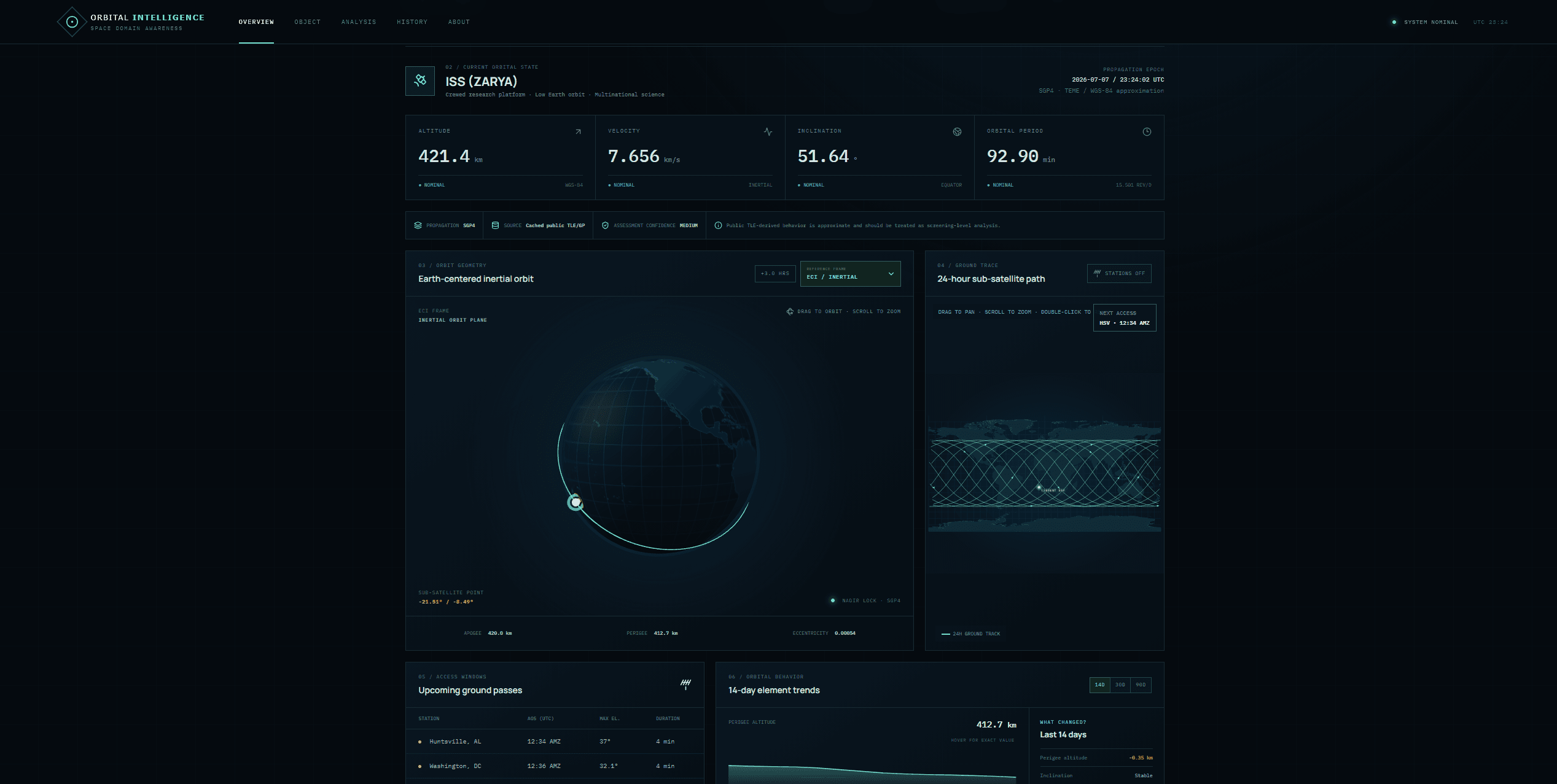 Repository output / project interface
01 / Overview
Project overview
The dashboard connects a React and Three.js interface to a FastAPI service. A checksum-valid TLE produces a current-state SGP4 estimate, an explicitly labeled TEME trajectory, an approximate Earth-fixed ground track, and sampled station-access windows. Orbital trends and change candidates appear only after the user supplies a time-ordered history for one NORAD object.
02 / Motivation
The problem
Public orbital data becomes misleading when frames, element age, assumptions, and evidence are hidden behind confident-looking conclusions. This project explores how to make simplified analysis useful without presenting it as operational truth.
03 / Method
Technical approach
The backend separates TLE validation, SGP4 propagation, coordinate conversion, access screening, and historical-element analysis behind a typed API. The historical workflow enforces a single NORAD identity and uses adaptive statistical thresholds to flag change candidates without claiming maneuver intent. The interface keeps source dates, reference frames, model limits, and screening caveats visible beside the results.
04 / Reflection
What I learned
The strongest analytical interfaces do not merely show an answer; they show what evidence supports it, what the model actually computed, and what cannot be concluded from the available data.