2026 NASA RASC-AL finalist / University of Texas at Austin
Project
DUSTEE
Demonstration of Up-scalable Surface Treatment for Earth-Moon Economy
A lunar surface systems concept designed to compare regolith compaction, solar sintering, and laser sintering through a repeatable measurement campaign—producing evidence for future roads, landing pads, and sustained surface infrastructure.
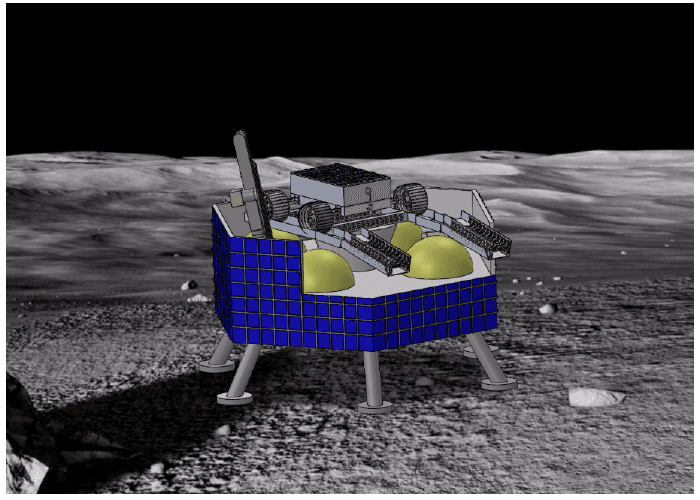
DUSTEE was one of 14 concepts selected as finalists for the 2026 NASA RASC-AL competition and competed in the Lunar Technology Demonstrations Leveraging Common Infrastructure theme.
The proposal addressed a foundational problem for sustained lunar activity: roads, landing zones, foundations, and other large surfaces cannot be shipped economically from Earth. They need scalable ways to use local regolith while controlling dust and producing surfaces with measurable mechanical performance.
The team therefore framed DUSTEE as an experiment, not a claim that one process had already won. A lander and rover would prepare controlled test areas, apply multiple surface treatments, and run the same verification loop across every condition. The result would be quantitative evidence for choosing future lunar surface-preparation methods.
Test configurations
Two preparation states crossed with three treatment states.
Sintering modes
Solar concentration and lander-powered diode-laser processing.
Verification modes
LiDAR roughness, compression response, and plume or dust observation.
Baseline surface demo
A structured operational sequence from landing through data return.
02 / The challenge
Lunar regolith is both a resource and an operational hazard.
Lunar regolith is abrasive, electrostatically troublesome, and easily mobilized by wheels or rocket plumes. At the same time, surface hardware must work within severe limits on delivered mass, available power, terrain access, thermal survival, communications, and autonomous operation.
DUSTEE treated those constraints as interfaces. The value of a sintered patch depended on how the rover compacted it, how the arm delivered energy, how instruments measured it, and how the team controlled geometry and operations across the test campaign.
03 / Technical approach
One architecture, six controlled conditions
One architecture supported six controlled conditions: uncompacted and wheel-compacted regolith, each tested with no sintering, solar sintering, or laser sintering. Holding test geometry and measurement constant made this a direct trade study rather than three isolated technology demonstrations.
- Mission concept. DUSTEE was organized as a lunar technology demonstration using a Commercial Lunar Payload Services lander and a deployable rover. The concept placed sintering hardware on a lander-mounted robotic arm while the rover prepared test areas and carried the verification instruments. A phased surface plan covered site selection, checkout, rover deployment, sintering, measurement, and optional post-night follow-up.
- Comparative surface experiment. The experiment compared six controlled configurations: uncompacted and wheel-compacted regolith, each tested with no sintering, solar sintering, or laser sintering. Holding test geometry and measurement procedures constant created a direct trade-study dataset instead of evaluating each technology in isolation.
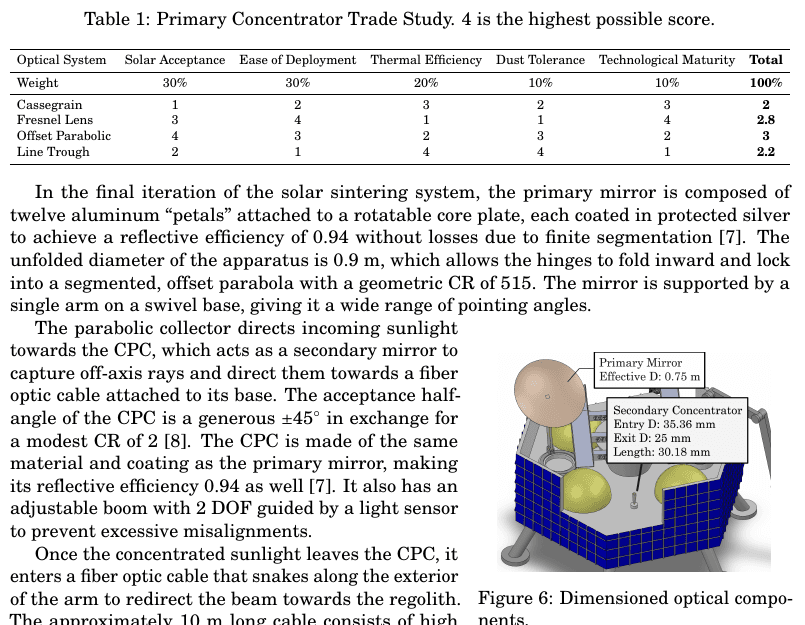
- Solar and laser sintering. Both processing methods used a seven-degree-of-freedom lander arm and interchangeable end effectors. The solar concept selected an offset parabolic concentrator through a weighted trade study, then routed concentrated sunlight through a compound parabolic concentrator, fiber optic cable, and quartz end effector. The laser concept used a continuous-wave 976 nm diode source, delivering approximately 70 W of optical power to an approximately 2 mm spot at a nominal 25–30 cm standoff.
- Common verification loop. The rover applied the same measurement sequence to every configuration: retrieve sintered pucks where applicable, record compression response, map surface roughness with LiDAR, expose the patch to a controlled nitrogen plume, and repeat the roughness scan. The resulting products addressed mechanical integrity, surface degradation, and dust or ejecta response.
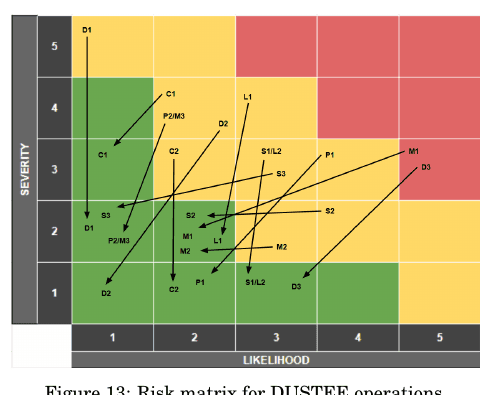
- Operations, power, and risk. The proposal treated site illumination, lander power, rover mobility, lunar-night survival, contamination, and subsystem interactions as coupled constraints. Nonessential hardware would be powered down during eclipse, while the rover survival architecture combined reduced loads, battery energy, passive insulation, and autonomous sunrise recovery. A mission-level risk matrix tracked dust, thermal, pressure, landing, and detector risks before and after mitigation.
04 / Analysis
Sintering analysis
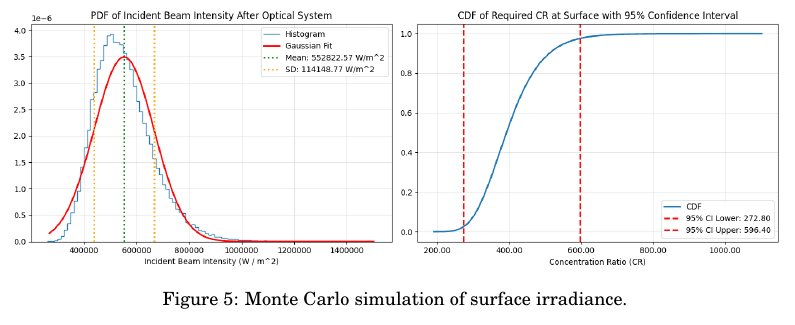
The solar-sintering analysis ran a 50,000-case Monte Carlo study over lunar-location and regolith-property uncertainty to estimate the irradiance needed at the surface, giving a 95% concentration-ratio interval of roughly 273 to 598. That range sized the optical architecture: an offset parabolic primary concentrator feeding a compound parabolic concentrator, a fiber delivery path, and a quartz end effector.
05 / My contribution
My contribution
I led the solar and laser sintering analysis and helped translate those subsystems into the technical documentation for the team. This was a multidisciplinary university team project; the lander, rover, verification payloads, operations plan, presentation, and final proposal were team outcomes.
- Led the sintering analysis, including the 50,000-case Monte Carlo study used to characterize the required solar-concentration range.
- Contributed to the solar-concentrator trade study and the selected optical-delivery architecture.
- Developed and documented the laser-sintering concept around a continuous-wave 976 nm diode source, delivery losses, spot sizing, raster speed, overlap, and turnaround power control.
- Connected subsystem assumptions to requirements, interfaces, figures, calculations, and the risk discussion in the technical paper.
06 / What I learned
What I learned
- Translate goals into measurable tests: “support lunar infrastructure” became controlled surfaces, shared geometry, and defined mechanical, roughness, and dust-response outputs.
- Design across interfaces: the sintering concept could not be separated from arm motion, power delivery, rover access, contamination control, and the operating timeline.
- Carry uncertainty into requirements: Monte Carlo analysis turned uncertain inputs into a design range rather than a single optimistic estimate.
- Make complex work reviewable: a credible proposal needs traceable assumptions, readable figures, and honest limitations.
07 / Public record
Official project material
NASA and the National Institute of Aerospace have published the competition record and finalist deliverables. The team paper, chart deck, poster, presentation, and review-panel Q&A are available through the official archive.
Competition archive
The canonical NIA archive for the technical paper, chart deck, poster, and forum presentation.
Open official archiveTechnical poster
The DUSTEE digital poster published by the National Institute of Aerospace.
View posterNASA finalist announcement
NASA's March 20, 2026 announcement naming DUSTEE among 14 national finalist teams.
Read NASA announcementForum presentation collection
The official RASC-AL Vimeo showcase containing the 2026 team presentations and review-panel Q&A.
Open presentation showcase08 / Technical paper
Full technical paper
The 31-page paper contains the full architecture, surface-operations plan, subsystem concepts, resource estimates, risk assessment, governing calculations, and references.